

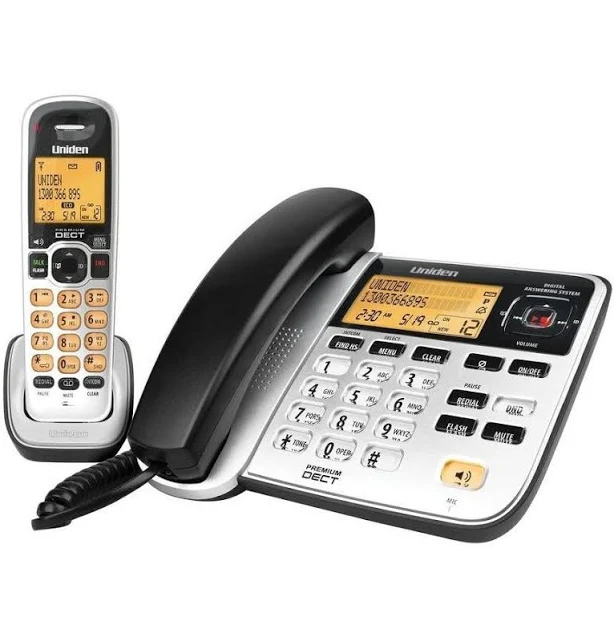
Uniden Cordless Phone
4.5(317)
From
$63.00
Across 18 retailers

48 products in the catalogue · 46 with prices across 8 retailers from $27 to $1390.
From
$63.00
Across 18 retailers

From
$44.00
Across 17 retailers


From
$72.00
Across 16 retailers

From
$89.88
Across 14 retailers

From
$24.95
Across 13 retailers

No reviews yet
From
$82.00
Across 13 retailers

From
$89.00
Across 13 retailers


From
$60.50
Across 12 retailers


From
$154.00
Across 12 retailers


From
$82.00
Across 11 retailers


From
$57.00
Across 10 retailers

From
$64.00
Across 10 retailers

No reviews yet
From
$74.00
Across 10 retailers
From
$60.00
Across 9 retailers
According to IBISWorld industry reports on telecommunications equipment retailing in Australia, the market remains stable despite the dominance of mobile technology. While mobile adoption is near-universal, landline systems maintain a consistent market share, valued at approximately $180 million annually, driven largely by home office requirements and elderly care needs. The Australian market exhibits distinct seasonal patterns, with retail activity peaking during the November Black Friday and Cyber Monday sales events. Additionally, the end-of-financial-year (EOFY) period in June sees a significant uptick in business-grade landline purchases as companies exhaust their technology budgets. Retailers often clear older stock during these cycles to make room for newer DECT (Digital Enhanced Cordless Telecommunications) models that feature improved range and interference management. Consumer data indicates that while volume sales have plateaued, the average transaction value has increased as households opt for multi-handset systems with integrated answering machines and call-screening technology. Understanding these cyclical trends is essential for consumers looking to secure the lowest possible price, as retailers frequently adjust inventory levels and promotional pricing in alignment with these specific Australian retail calendar milestones.
| Retailer | Products tracked | Price range |
|---|---|---|
| eBay | 33 | $44.00 – $1390.00 |
| Woolworths | 21 | $29.85 – $259.95 |
| JB Hi-Fi | 20 | $54.00 – $359.00 |
| BIG W | 20 | $29.95 – $449.95 |
| Kogan.com | 19 | $27.00 – $439.95 |
| Bunnings Warehouse | 18 | $50.15 – $349.00 |
| Harvey Norman | 9 | $64.00 – $279.00 |
| Dick Smith AU | 9 | $27.00 – $139.00 |
When purchasing a landline phone in Australia, ensure the device is compliant with local standards, specifically the 230V/50Hz power supply requirements. Most major brands sold locally are pre-configured for these specifications, but parallel imports may require adapters that could void warranties or pose safety risks. Key features to consider include DECT 6.0 technology for interference-free communication, nuisance call blocking, and GAP (Generic Access Profile) compatibility, which allows you to mix and match handsets from different manufacturers. For Australian homes with larger floor plans, look for models with range-extender support. Timing your purchase is critical to securing value; the best prices are typically found during major sales events such as Click Frenzy in May and November, Boxing Day sales in December, and the EOFY sales in June. A common pitfall is purchasing a phone that lacks NBN (National Broadband Network) compatibility; ensure your chosen model connects directly to your modem's phone port rather than requiring an outdated wall socket connection. Always check if the handset includes a battery backup feature, which is vital in Australia to maintain connectivity during local power outages, as many modern NBN-connected phones will not function without mains power.
Yes, landline phones remain fully functional with the NBN, but the connection method has changed. Instead of plugging your phone into a traditional wall socket, you must connect it to the 'Phone' or 'UNI-V' port on your NBN modem. If you have an older analogue phone, it will work through this port, though you may need an adapter. It is important to note that if your NBN connection loses power, your landline will likely stop working unless you have a battery backup unit or a mobile-linked system.
DECT stands for Digital Enhanced Cordless Telecommunications. It is the global standard for cordless phones, operating on a dedicated frequency band that prevents interference from Wi-Fi routers, baby monitors, and other household electronics. Unlike older analogue cordless phones, DECT technology provides superior sound quality, better range, and enhanced security, as the signal is digitally encrypted between the handset and the base station. Most modern landline phones sold in Australia use DECT 6.0 technology to ensure a stable, high-quality connection throughout the home.
Yes, most modern landline systems are designed to support multiple handsets from a single base station. When purchasing, look for 'multi-handset' packs, which often include two, three, or four handsets. If you need to add more later, ensure the system is GAP (Generic Access Profile) compatible. GAP is an international standard that allows handsets from different manufacturers to register with a base station from another brand, though some advanced features like shared phonebooks may only work when using handsets from the same manufacturer as the base.
Many contemporary landline phones sold in Australia feature built-in 'Nuisance Call Blocking' or 'Smart Blocking' technology. These systems allow you to manually block specific numbers or use a 'whitelist' feature where only numbers saved in your contacts can ring the phone. Some advanced models include a dedicated 'Block' button that can be pressed during or after an unwanted call to add the number to a blacklist. If your phone does not have this feature, you can contact your telephone service provider to inquire about network-level call-blocking services.
In the NBN era, landline phones are powered by your modem, which requires mains electricity to function. Unlike the old copper network, which provided power through the telephone line itself, modern digital lines are dependent on your home's power supply. If the power goes out, your modem will shut down, causing the landline to lose its signal. To maintain connectivity during an outage, you would need an Uninterruptible Power Supply (UPS) for your modem or a cordless phone system that includes a battery backup feature in the base station.