
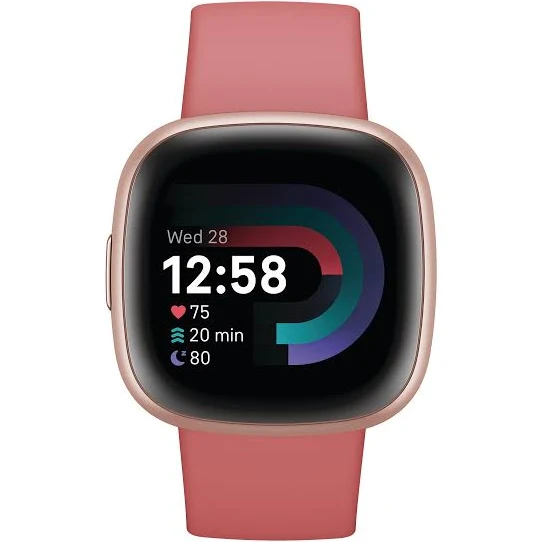
Fitbit Versa 4 - Pink Sand/Copper Rose Aluminium
4.2(7K)
From
$239.00
Across 15 retailers

674 products in the catalogue · 541 with prices across 8 retailers from $19 to $3842.
From
$239.00
Across 15 retailers
From
$295.00
Across 14 retailers
From
$369.00
Across 14 retailers
From
$547.00
Across 14 retailers
From
$24.00
Across 13 retailers

From
$149.00
Across 13 retailers
From
$299.00
Across 13 retailers
From
$398.00
Across 13 retailers
From
$529.00
Across 13 retailers
From
$747.00
Across 13 retailers
From
$59.97
Across 12 retailers
From
$68.99
Across 12 retailers
From
$74.00
Across 12 retailers
From
$129.00
Across 12 retailers
From
$140.99
Across 12 retailers
From
$199.00
Across 12 retailers
According to an IBISWorld industry report on consumer electronics retailing in Australia, the wearable technology sector has experienced consistent growth, with market revenue reaching approximately $1.2 billion annually. This expansion is driven by increasing consumer health awareness and the integration of smart watches into daily fitness routines. In the Australian retail landscape, demand for smart watches follows distinct cyclical patterns. Sales volume typically spikes during the fourth quarter, coinciding with the holiday shopping season and the lead-up to Christmas. Additionally, the mid-year period sees significant activity as retailers clear inventory before the end of the financial year. These seasonal trends are often amplified by major promotional events that encourage consumers to upgrade their wearable devices. As Australian households continue to prioritize health-tech integration, the market remains highly competitive, with retailers frequently adjusting pricing strategies to maintain market share against global tech giants. Understanding these cycles is essential for consumers looking to time their purchases during periods of peak discounting.
| Retailer | Products tracked | Price range |
|---|---|---|
| JB Hi-Fi | 244 | $53.00 – $2049.00 |
| eBay | 234 | $19.00 – $3841.78 |
| Woolworths | 156 | $19.95 – $2110.06 |
| BIG W | 133 | $24.00 – $3359.05 |
| Dick Smith AU | 131 | $19.95 – $2047.00 |
| Kogan.com | 113 | $19.95 – $2047.00 |
| The Good Guys | 73 | $144.00 – $1294.00 |
| Harvey Norman | 72 | $88.00 – $2048.00 |
When purchasing a smart watch in Australia, timing is critical to securing the lowest price. Major savings are consistently found during the End of Financial Year (EOFY) sales in June, Click Frenzy events in May and November, Black Friday in late November, and the traditional Boxing Day sales in December. When evaluating specs, prioritize battery life, water resistance ratings (IP68 or 5ATM), and compatibility with your existing smartphone ecosystem. Ensure the device supports Australian power standards, specifically the 230V/50Hz AC supply, though most modern smart watches use standard USB-C or proprietary magnetic charging cradles that are safe for local use. A common pitfall is ignoring the climate; if you are an outdoor runner, ensure the screen brightness is sufficient for harsh Australian sunlight and that the GPS is multi-band for better accuracy in dense urban or bush environments. Always verify that the model sold is the Australian-compliant version to ensure local warranty support and full functionality of features like contactless payments, which are integrated with major Australian banking institutions. Avoid grey-market imports that may lack local warranty coverage or have restricted regional features.
Not all smart watches support contactless payments in Australia. While major platforms like Apple Pay, Google Pay, and Samsung Pay are widely supported by most Australian banks, some proprietary smart watch operating systems have limited compatibility. Before purchasing, check if your specific bank is listed as a partner for the watch's payment service. Many smaller or regional credit unions may not be supported even if the major banks are, so verifying the list on the manufacturer's official Australian website is a necessary step.
Yes, under the Australian Consumer Law, products sold by Australian retailers are covered by consumer guarantees. This provides you with rights to a repair, replacement, or refund if the device is faulty, not fit for purpose, or does not match its description. These rights exist independently of any manufacturer's warranty. If you purchase from an overseas retailer, enforcing these rights can be significantly more difficult, which is why buying from local authorised retailers is generally recommended for high-value electronics.
A cellular-enabled smart watch allows you to make calls, send texts, and stream music without your phone nearby. In Australia, this requires an active eSIM plan from a local carrier like Telstra, Optus, or Vodafone. These plans usually incur an additional monthly fee on top of your existing mobile contract. If you frequently exercise outdoors without your phone or prefer to stay connected while leaving your device behind, the cellular model is highly beneficial. Otherwise, a standard GPS-only model is usually sufficient.
Compatibility depends on the operating system. Apple Watches require an iPhone and generally do not work with Android devices. Conversely, most Android-based smart watches, such as those running Wear OS, are compatible with most Android phones but often have limited or no functionality when paired with an iPhone. Always check the manufacturer's specifications for the minimum required OS version, such as iOS 15 or Android 10, to ensure your current smartphone can successfully sync with the watch features.
An IP rating, such as IP68, indicates how well a device resists dust and water. However, 'water-resistant' does not mean 'waterproof.' Most smart watches with an IP68 rating are designed for freshwater and may be damaged by salt water or pool chemicals. If you intend to swim in the ocean or surf, look for a watch with a 5ATM or 10ATM rating, which is specifically tested for pressure at depth. Always rinse your watch with fresh water after exposure to salt or chlorine to prevent corrosion.